Introduction
AI Governance & Policy Tools are specialized platforms designed to oversee, manage, and audit an organization’s AI and machine learning initiatives. Unlike standard MLOps tools that focus on building models, governance tools focus on the “guardrails”—ensuring that every algorithm is fair, transparent, secure, and compliant with global regulations. These platforms act as a centralized system of record, documenting everything from data lineage and model versioning to bias detection and risk assessments.
The importance of these tools cannot be overstated. Without a robust governance framework, companies face massive legal liabilities, reputational damage from “hallucinating” or biased AI, and the risk of significant financial loss. Real-world use cases include automating compliance reports for financial audits, detecting disparate impact in hiring algorithms, and monitoring Large Language Models (LLMs) for toxic output or sensitive data leakage. When evaluating a tool, users should prioritize automated documentation, real-time bias monitoring, native integration with existing ML pipelines, and the ability to map technical metrics to legal requirements.
Best for: Large enterprises in highly regulated sectors like finance, healthcare, and government. It is also essential for Compliance Officers, Data Scientists, and Legal Counsel in any organization scaling AI beyond simple internal experiments.
Not ideal for: Small startups with only one or two non-customer-facing models or academic researchers who do not need to meet commercial regulatory standards. In these cases, open-source libraries like Fairlearn or simple internal documentation may suffice.
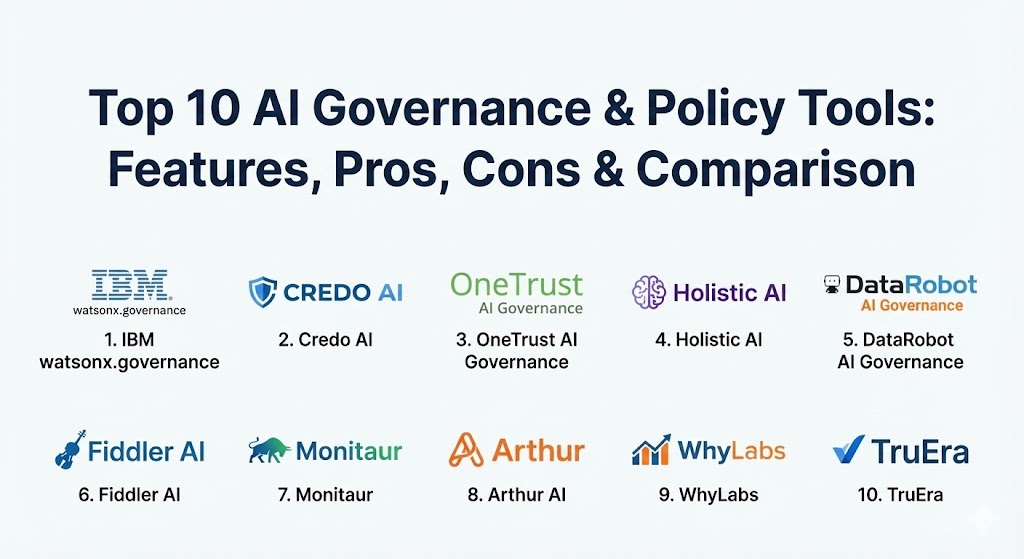
Top 10 AI Governance & Policy Tools
1 — IBM watsonx.governance
IBM’s offering is a titan in the enterprise space, providing a unified platform to automate AI governance across the entire lifecycle. It is specifically designed to help businesses direct, manage, and monitor their AI activities regardless of where the models are built.
- Key features:
- Automated Documentation: Captures model metadata and facts automatically to create a “Model Card.”
- Risk Management: Identifies and mitigates risks associated with both generative AI and predictive ML.
- Regulatory Compliance: Maps technical performance to frameworks like the EU AI Act and NIST.
- Lifecycle Tracking: Provides a transparent view of data, models, and deployments.
- Bias & Drift Monitoring: Real-time alerts for performance degradation or unfair outcomes.
- Pros:
- Unparalleled integration with the broader IBM Watson ecosystem.
- Highly scalable for global organizations with thousands of models.
- Cons:
- Can feel overly complex and “heavy” for smaller teams.
- Pricing is geared toward large enterprise budgets.
- Security & compliance: SOC 2, GDPR, HIPAA, ISO 27001, and FIPS 140-2. Includes robust SSO and audit logging.
- Support & community: Extensive documentation, dedicated enterprise support, and a massive global user base.
2 — Credo AI
Credo AI is a pure-play governance leader that focuses on the “Policy Intelligence” side of the equation. It is designed to bridge the gap between technical teams and compliance/legal departments.
- Key features:
- Policy Intelligence: Translates complex laws into actionable technical requirements.
- AI Registry: A centralized inventory for all in-house and third-party AI assets.
- GenAI Guardrails: Specific controls for managing risks like IP leakage in LLMs.
- Automated Governance Artifacts: One-click generation of compliance reports and model cards.
- Vendor Risk Management: Evaluates the safety of third-party AI tools before they are adopted.
- Pros:
- Extremely user-friendly for non-technical stakeholders (Legal, Risk).
- Best-in-class for regulatory alignment and “future-proofing” against new laws.
- Cons:
- Less emphasis on deep technical model monitoring compared to MLOps-native tools.
- Can be expensive for organizations with a limited number of use cases.
- Security & compliance: SOC 2 Type II, GDPR, and NIST RMF alignment. SSO and encrypted data storage.
- Support & community: Strong thought leadership, high-quality webinars, and responsive customer success teams.
3 — OneTrust AI Governance
OneTrust has leveraged its dominance in the privacy and GRC (Governance, Risk, and Compliance) market to build a robust AI governance module. It is perfect for organizations that want to integrate AI oversight into their existing privacy workflows.
- Key features:
- Privacy Integration: Seamlessly connects AI risk to data privacy impact assessments (DPIA).
- Automated Workflows: Trigger governance reviews based on specific data types or use cases.
- Algorithm Inventory: Tracks model versions and ownership across the business.
- Ethics Assessment: Pre-built templates for ethical AI reviews.
- Global Regulation Mapping: Covers over 50 global jurisdictions.
- Pros:
- Ideal for teams already using OneTrust for GDPR or CCPA compliance.
- Very strong at handling the “Data” part of AI governance.
- Cons:
- The UI can feel cluttered due to the sheer breadth of the platform.
- Initial setup and customization can be time-consuming.
- Security & compliance: SOC 2, ISO 27001, GDPR, HIPAA, and CCPA.
- Support & community: Massive resource library and a global support network.
4 — Holistic AI
Holistic AI is built on the philosophy of “quantifying risk.” It provides deep technical auditing and monitoring to ensure that AI systems are performing safely and equitably.
- Key features:
- Risk Quantification: Assigns measurable scores to financial and reputational AI risks.
- AI Asset Discovery: Automatically uncovers “Shadow AI” running in the organization.
- Algorithmic Auditing: Detailed evidence-based audits for high-stakes models.
- Continuous Monitoring: Tracks drift and bias in production environments.
- Business Value Tracking: Connects governance metrics to ROI.
- Pros:
- Excellent for high-stakes industries (e.g., insurance, hiring) where auditing is mandatory.
- Very strong technical depth in bias detection.
- Cons:
- The learning curve can be steep for non-data scientists.
- Integration with certain legacy ML pipelines may require custom work.
- Security & compliance: GDPR, NIST, and ISO 42001 support. SSO and role-based access controls.
- Support & community: Technical documentation and expert-led advisory workshops.
5 — DataRobot AI Governance
DataRobot provides an end-to-end platform that integrates governance directly into the model development and deployment process. It is a “deployment-first” governance tool.
- Key features:
- Centralized Oversight: Manage generative and predictive AI from one hub.
- Automated Compliance Documentation: One-click generation of audit-ready evidence.
- Real-time AI Defense: “Guards” to monitor for hallucinations or PII leakage in LLMs.
- Pre-deployment Red-Teaming: Test models for vulnerabilities before they go live.
- Compute Optimization: Tracks costs and resource usage across deployments.
- Pros:
- Highly efficient for teams that want a single tool for both MLOps and Governance.
- Very fast deployment-to-governance cycle.
- Cons:
- Most effective when used within the DataRobot ecosystem.
- Can be a “heavy” infrastructure lift for companies only wanting a policy layer.
- Security & compliance: SOC 2, GDPR, HIPAA, and FEDRAMP availability.
- Support & community: Dedicated customer success and a robust online training academy (DataRobot University).
6 — Fiddler AI
Fiddler is a pioneer in “Model Performance Management” (MPM). It excels at the technical aspects of governance—observability, explainability, and fairness.
- Key features:
- Explainable AI (XAI): Uses advanced techniques like SHAP to explain why a model made a specific decision.
- Fiddler Guardrails: Specifically designed to monitor LLMs for safety and correctness.
- Fairness Metrics: Tracks disparate impact and demographic parity in real-time.
- Agentic Observability: Monitors complex multi-agent AI systems for performance.
- Root Cause Analysis: Drills down into underperforming data segments.
- Pros:
- Industry-leading explainability tools.
- Excellent “unified” dashboard for both traditional ML and GenAI.
- Cons:
- Primarily a technical tool; may lack some of the higher-level GRC features found in OneTrust.
- Pricing is targeted at the enterprise mid-market and above.
- Security & compliance: SOC 2 Type II, GDPR, and ISO 27001.
- Support & community: Strong community presence and high-quality technical blog.
7 — Monitaur
Monitaur is a specialized governance platform that prides itself on being a “source of truth” for regulated sectors. It is highly favored by the insurance and banking industries.
- Key features:
- Controls Library: A library of best practices that can be mapped to model workflows.
- Decision Logging: Keeps a permanent, searchable record of every model transaction.
- Modular Policy Templates: Ready-to-use templates for enterprise AI policies.
- Continuous Validation: Stress-tests models against regulatory requirements.
- Collaborative Workflows: Connects technical, legal, and business teams.
- Pros:
- Purpose-built for highly regulated “high-consequence” AI.
- Excellent onboarding with a “Launch in 90 Days” methodology.
- Cons:
- Narrower focus on heavily regulated industries may make it less relevant for general e-commerce or creative firms.
- UI is functional but lacks the modern “flash” of newer SaaS tools.
- Security & compliance: SOC 2, GDPR, and specific alignment with insurance regulations (e.g., NAIC).
- Support & community: High-touch customer support and expert workshops.
8 — Arthur AI
Arthur is an observability and governance platform that focuses on helping enterprises deliver on the promise of “Responsible AI.”
- Key features:
- Performance Monitoring: Tracks data drift and accuracy in production.
- Arthur Bench: An open-source tool for evaluating and comparing LLMs.
- Fairness Analytics: Detects and corrects bias across various protected classes.
- Outlier Detection: Identifies anomalous data points that might trigger model failures.
- Customizable Alerts: Tailor notifications for specific governance thresholds.
- Pros:
- Very strong focus on the LLM evaluation lifecycle.
- The “Bench” tool is a massive advantage for companies selecting which foundation model to use.
- Cons:
- Free tier is limited; enterprise costs can scale quickly.
- Less focus on automated legal document generation than Credo AI.
- Security & compliance: SOC 2, GDPR, and HIPAA. SSO and granular RBAC.
- Support & community: Active open-source presence and responsive enterprise support.
9 — WhyLabs
WhyLabs is a “Control Center” for AI. It is designed to be lightweight and easy to integrate, focusing on the observability side of the governance coin.
- Key features:
- Privacy-Preserving Monitoring: Tracks data without moving it from the user’s environment.
- Data Quality Alerts: Catches schema changes or missing values that break models.
- LLM Security Guardrails: Monitors for prompt injections and PII leakage.
- Segment Analysis: Investigates performance across different slices of data.
- Seamless Integrations: Works with nearly any data pipeline (batch or streaming).
- Pros:
- Very easy to “get started” compared to heavy enterprise platforms.
- Cost-efficient for teams with massive data volumes.
- Cons:
- Focused more on observability than on high-level policy management.
- May require integration with a separate GRC tool for full compliance documentation.
- Security & compliance: GDPR and SOC 2. Privacy-first architecture.
- Support & community: Excellent documentation and an active Slack community.
10 — TruEra
TruEra focuses on “Model Quality.” It provides the technical depth needed to verify that a model is ready for a governed production environment.
- Key features:
- TruLens: An open-source library for evaluating LLM applications.
- Root Cause Analysis: Pinpoints exactly why a model is drifting or failing.
- Quality Testing: Pre-deployment testing for fairness and reliability.
- Explainability Dashboards: High-level views of model logic for stakeholders.
- Model Lifecycle Documentation: Tracks the “provenance” of a model from birth to retirement.
- Pros:
- Exceptional depth in model quality metrics.
- The TruLens library is a standard in the LLM development community.
- Cons:
- Can be very technical; may alienate non-technical compliance officers.
- Primarily focused on the model layer rather than the data privacy layer.
- Security & compliance: SOC 2, GDPR, and ISO 27001 support.
- Support & community: Robust open-source community and comprehensive enterprise support plans.
Comparison Table
| Tool Name | Best For | Platform(s) Supported | Standout Feature | Rating (Gartner Peer Insights) |
| IBM watsonx.governance | Large Enterprise Stack | Cloud, Hybrid, On-Prem | Automated Lifecycle Tracking | 4.6 / 5 |
| Credo AI | Regulatory Compliance | SaaS, Private Cloud | Regulatory Policy Packs | 4.5 / 5 |
| OneTrust AI Governance | GRC & Privacy Teams | SaaS | DPIA & Privacy Sync | 4.3 / 5 |
| Holistic AI | Risk Auditing | SaaS, Hybrid | Risk Quantification Scores | 4.7 / 5 |
| DataRobot | Integrated MLOps | Cloud, Hybrid, Edge | Real-time AI “Shields” | 4.7 / 5 |
| Fiddler AI | Explainability & Observability | SaaS, Hybrid | Deep SHAP Explainability | 4.5 / 5 |
| Monitaur | InsureTech & Banking | SaaS, Private Cloud | Controls Library & Auditing | 4.6 / 5 |
| Arthur AI | LLM Evaluation | SaaS, Self-hosted | Arthur Bench for LLM Eval | 4.4 / 5 |
| WhyLabs | Data Quality & Observability | SaaS, On-Prem | Privacy-Preserving Monitoring | 4.8 / 5 |
| TruEra | Model Quality Assurance | SaaS, Hybrid | Root Cause Drift Analysis | 4.5 / 5 |
Evaluation & Scoring of AI Governance & Policy Tools
To help you decide which tool fits your needs, we have evaluated the top contenders based on a weighted scoring rubric that reflects the priorities of a 2026 enterprise.
| Category | Weight | IBM watsonx | Credo AI | OneTrust | Holistic AI |
| Core Features | 25% | 10 / 10 | 9 / 10 | 8 / 10 | 9 / 10 |
| Ease of Use | 15% | 7 / 10 | 9 / 10 | 6 / 10 | 7 / 10 |
| Integrations | 15% | 9 / 10 | 8 / 10 | 10 / 10 | 7 / 10 |
| Security & Compliance | 10% | 10 / 10 | 9 / 10 | 10 / 10 | 9 / 10 |
| Performance/Reliability | 10% | 10 / 10 | 8 / 10 | 8 / 10 | 9 / 10 |
| Support & Community | 10% | 9 / 10 | 9 / 10 | 9 / 10 | 8 / 10 |
| Price / Value | 15% | 7 / 10 | 8 / 10 | 7 / 10 | 8 / 10 |
| Total Weighted Score | 100% | 8.75 | 8.60 | 8.05 | 8.20 |
Which AI Governance & Policy Tool Is Right for You?
Selecting the right tool depends on your current “AI Maturity” and your specific organizational hurdles.
- Solo Users vs SMB vs Mid-Market vs Enterprise:
- Solo/Small Teams: You likely don’t need a full platform. Use open-source libraries like TruLens or WhyLabs to monitor your models without the enterprise price tag.
- Mid-Market: Credo AI or Fiddler AI offer the best balance of sophisticated features and manageable implementation.
- Large Enterprise: IBM watsonx.governance or OneTrust are the go-to choices for handling global scale and complex cross-departmental workflows.
- Budget-Conscious vs Premium Solutions:
- If you have a tight budget, look for “Observability-first” tools like WhyLabs which have more flexible entry points. Premium suites like DataRobot and IBM provide much more automation but require significant upfront investment.
- Feature Depth vs Ease of Use:
- If you need deep technical audits for a high-risk hiring or lending model, go for Holistic AI. If you need a dashboard that your Head of Legal can understand and use tomorrow, go for Credo AI.
- Security and Compliance Requirements:
- If you are in the public sector or defense, prioritize tools with FedRAMP or on-premise options like Monitaur or IBM. If your main concern is the EU AI Act, Credo AI has the most specialized “Policy Packs” to handle those specific requirements.
Frequently Asked Questions (FAQs)
1. What is the difference between MLOps and AI Governance?
MLOps focuses on the efficiency of the machine learning pipeline (building, deploying, scaling). AI Governance focuses on the controls (fairness, safety, transparency, and regulatory compliance) of those same models.
2. Can these tools govern Generative AI and LLMs?
Yes, most leading tools (like Fiddler, DataRobot, and Arthur) now include specific features for “GenAI Guardrails,” which monitor for hallucinations, prompt injections, and PII leakage in real-time.
3. Is the EU AI Act supported by these tools?
Absolutely. Regulatory mapping is a core feature for tools like Credo AI and IBM watsonx. They provide templates that automatically map your model’s technical metrics to the specific reporting requirements of the EU AI Act.
4. How long does it take to implement an AI Governance tool?
A basic setup for a single model can take a few weeks. However, for a full enterprise-wide rollout covering hundreds of models, expect a timeline of 3 to 6 months to fully integrate policies and workflows.
5. Do these tools impact model performance or latency?
Most modern tools use “out-of-band” monitoring or “privacy-preserving agents” that have negligible impact on the actual inference speed of your models.
6. Can I use these tools if I build my models on AWS or Azure?
Yes, the best governance tools are “vendor-agnostic.” For example, IBM watsonx.governance can monitor models running on AWS SageMaker, Azure ML, or even local servers.
7. Who in my company should “own” the governance tool?
AI Governance is a “team sport.” Usually, the Chief Data Officer (CDO) or a designated AI Lead owns the platform, while Compliance, Legal, and Data Scientists all have different levels of access.
8. Are there free or open-source alternatives?
Yes, libraries like Fairlearn (for bias), SHAP (for explainability), and TruLens (for LLM evaluation) are excellent starting points, but they lack the centralized management and “audit-ready” reporting of enterprise tools.
9. What is “Shadow AI” and can these tools find it?
Shadow AI refers to AI tools or models being used by employees without IT approval. Platforms like Holistic AI can scan your infrastructure to detect unauthorized AI activity.
10. How do I justify the cost of an AI Governance tool to my CEO?
Framing it as “Risk Mitigation” is key. A single bias lawsuit or a regulatory fine under the EU AI Act (which can be millions of Euros) far outweighs the annual cost of a governance platform.
Conclusion
The era of “black-box” AI is officially over. In 2026, transparency is not just an ethical choice; it is a business requirement. Choosing the right AI Governance & Policy tool means finding a partner that can scale with your innovation while keeping you on the right side of the law.
Whether you prioritize the technical explainability of Fiddler AI, the regulatory focus of Credo AI, or the massive enterprise reach of IBM, the key is to start now. The “best” tool is ultimately the one that moves governance from a manual, stressful hurdle to an automated, value-driving part of your AI strategy.