Introduction
LLM orchestration frameworks are specialized software libraries and platforms designed to streamline the integration of large language models into functional applications. They serve as the connective tissue between the model, external data (via RAG), APIs, and user interfaces. By abstracting away the boilerplate code required for prompt management, state handling, and tool-calling, these frameworks allow developers to focus on the high-level logic of their AI agents and assistants.
In 2026, the importance of orchestration has only intensified as we move from simple “chat” interfaces to autonomous agentic systems. These frameworks enable Retrieval-Augmented Generation (RAG) at scale, facilitate multi-agent collaboration, and ensure that AI outputs are grounded in real-time, proprietary data. Key evaluation criteria for these tools include the level of abstraction, the breadth of the integration ecosystem, the robustness of state management, and the support for “agentic” loops—where the AI can reason and correct its own path.
Best for: AI engineers, Full-stack developers, and Data Science teams ranging from fast-moving startups to Fortune 500 enterprises. They are essential for anyone building production-grade RAG systems, autonomous agents, or complex “Copilot” style applications that require more than a single API call.
Not ideal for: Simple, single-turn chatbot implementations where a direct API call to a provider like OpenAI or Anthropic is sufficient. They may also be overkill for researchers focusing purely on model training or fine-tuning without any need for external tool integration.
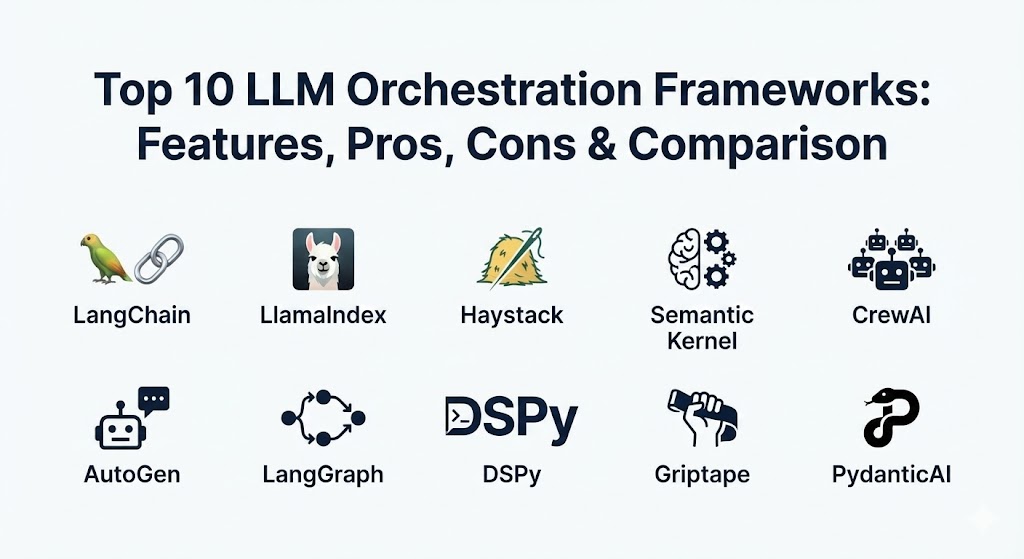
Top 10 LLM Orchestration Frameworks
1 — LangChain
LangChain is the most recognized and widely adopted framework in the AI ecosystem. It pioneered the concept of “chains”—sequences of operations that combine LLM calls with data preprocessing and tool usage. In 2026, it remains the standard-bearer for general-purpose AI orchestration.
- Key features:
- LangChain Expression Language (LCEL): A declarative way to compose components into complex sequences.
- Extensive Integrations: Over 700+ connectors for vector databases, model providers, and document loaders.
- Memory Management: Built-in abstractions for conversation history and persistent state.
- Standardized Prompt Templates: A unified system for managing and versioning prompts across different models.
- Tool-Calling Abstractions: Simplified logic for allowing LLMs to interact with external APIs.
- Pros:
- Massive community support and an unparalleled library of pre-built “recipes.”
- Extremely flexible and model-agnostic, preventing vendor lock-in.
- Cons:
- Significant abstraction overhead can make debugging difficult for complex loops.
- The API has historically evolved rapidly, sometimes leading to breaking changes.
- Security & compliance: Supports SSO, encryption at rest, and detailed audit logs through LangSmith. GDPR and SOC 2 compliance depends on the deployment environment (Cloud vs. Self-hosted).
- Support & community: Industry-leading documentation, a massive Discord community, and official enterprise support through LangChain Inc.
2 — LlamaIndex
While LangChain is for general orchestration, LlamaIndex is the specialist for Data-Centric AI. It focuses heavily on the “Retrieval” part of RAG, providing advanced tools to ingest, index, and query large datasets from disparate sources.
- Key features:
- Data Connectors (LlamaHub): Native support for indexing Notion, Slack, SQL databases, and PDFs.
- Advanced Indexing: Unique structures like Tree Indexes and Property Graphs for complex data relationships.
- Query Engines: Highly optimized interfaces for asking questions over indexed data.
- LlamaParse: A specialized tool for parsing complex tables and layouts in PDF documents.
- Observability Integrations: Native “hooks” for tracing and evaluating RAG performance.
- Pros:
- The best-in-class tool for building knowledge assistants and semantic search engines.
- Simplifies the “plumbing” of RAG, making it easy to handle unstructured data.
- Cons:
- Less focused on autonomous “agent” logic compared to other frameworks.
- Can become expensive if using their managed parsing services at high volume.
- Security & compliance: GDPR and HIPAA compliant options available via private cloud deployments. Provides RBAC for data access.
- Support & community: Excellent documentation and a very active developer community focused on data engineering and RAG.
3 — Haystack (by deepset)
Haystack is an industrial-strength, modular framework designed for production-ready search and question-answering systems. It is preferred by enterprise teams who value performance and a “pipeline-first” architecture.
- Key features:
- Component-Based Design: Every part of the system (Retriever, Generator, Ranker) is a standalone component.
- REST API Generation: Easily turn any Haystack pipeline into a production-ready API.
- Multi-Modal Support: Orchestrates workflows for text, image, and audio processing.
- Evaluation Pipelines: Built-in tools to measure the precision and recall of your AI system.
- Enterprise Scalability: Designed to handle high-throughput workloads with ease.
- Pros:
- Highly modular and transparent, making it easier to debug and optimize than “black-box” frameworks.
- Strong emphasis on production stability and “clean code” principles.
- Cons:
- Steeper learning curve for developers used to simpler, sequential script-writing.
- Smaller ecosystem of community-contributed “tools” compared to LangChain.
- Security & compliance: ISO 27001 and SOC 2 compliant; offers dedicated enterprise support for secure, on-premise deployments.
- Support & community: Professional enterprise support from deepset; active community on Slack and GitHub.
4 — Semantic Kernel (by Microsoft)
Semantic Kernel is Microsoft’s answer to AI orchestration. It is designed to integrate LLMs into professional software development environments, with native support for C#, Python, and Java.
- Key features:
- Skill-Based Architecture: Encapsulates prompts and functions into reusable “skills.”
- Native Microsoft Integration: Seamless connection to Azure OpenAI, Azure AI Search, and Microsoft Graph.
- Planner Functionality: An AI-driven “brain” that automatically figures out which skills to call to achieve a goal.
- Multi-Language Support: First-class support for the .NET ecosystem, making it a favorite for enterprise IT.
- Kernel Memory: A specialized service for indexing and retrieving enterprise documents.
- Pros:
- Perfect for organizations already invested in the Microsoft/Azure ecosystem.
- Provides a highly structured, deterministic way to build AI apps.
- Cons:
- Can feel overly “corporate” or verbose for Python-first data scientists.
- Documentation for non-C# languages has historically lagged behind.
- Security & compliance: Inherits Azure’s top-tier compliance certifications (HIPAA, SOC 2, GDPR, FedRAMP).
- Support & community: Backed by Microsoft’s enterprise support; strong community within the Microsoft developer network.
5 — CrewAI
CrewAI focuses on Collaborative Role-Playing Agents. It allows developers to define a “crew” of agents with specific roles (e.g., Researcher, Writer, Editor) and orchestrates their collaboration to complete complex tasks.
- Key features:
- Role-Based Orchestration: Agents are assigned specific personas and goals.
- Process Driven: Support for sequential, hierarchical, and consensual processes.
- Lightweight Design: Built on top of LangChain but with a much simpler, cleaner API.
- Task Delegation: Agents can automatically delegate sub-tasks to other agents in the crew.
- Custom Tool Support: Easily equip agents with specific Python functions or API clients.
- Pros:
- Extremely intuitive for building complex, multi-agent workflows.
- High level of control over how agents interact and hand off work.
- Cons:
- Still relatively new; the ecosystem of pre-built “crews” is growing but not yet massive.
- Debugging “agent logic” (why an agent failed a task) can be time-consuming.
- Security & compliance: Varies; primarily dependent on the underlying model provider and hosting environment.
- Support & community: Very active Discord community and rapidly expanding documentation.
6 — AutoGen (by Microsoft Research)
AutoGen is a framework for building multi-agent systems where agents can converse with each other to solve tasks. It is famous for its “Agent-to-Agent” conversation paradigm.
- Key features:
- Conversational Multi-Agent Systems: Agents solve problems through automated dialogue.
- Code Execution: Agents can write and execute code in a sandbox to solve math or programming tasks.
- Human-in-the-Loop: Allows humans to interject into agent conversations at any time.
- Customizable Roles: Highly flexible agent configurations with different LLMs or prompts.
- Task-Centric Optimization: Designed to maximize task completion rates through iterative feedback.
- Pros:
- Exceptional at solving complex, multi-step problems that require code execution.
- Highly flexible; supports virtually any communication pattern between agents.
- Cons:
- Can lead to “infinite loops” where agents talk to each other without finishing if not properly constrained.
- Higher token usage due to the conversational overhead.
- Security & compliance: N/A (Open-source); users must implement their own sandboxing for code execution.
- Support & community: Strong backing from Microsoft Research; active GitHub and Discord communities.
7 — LangGraph
LangGraph is a specialized extension of LangChain designed for building stateful, multi-actor applications with cycles. It treats agentic workflows as a directed graph.
- Key features:
- Cyclic Workflows: Unlike standard chains, LangGraph allows for loops (crucial for iterative reasoning).
- Persistence: Built-in “checkpoints” to save agent state and resume later.
- Multi-Agent Coordination: Explicit control over which agent speaks when and how state is shared.
- Fine-Grained Control: Provides lower-level control than standard LangChain agents.
- Human-in-the-Loop: Native support for pausing execution for human approval.
- Pros:
- The most robust tool for building complex, long-running agentic systems.
- Seamlessly integrates with the entire LangChain ecosystem of tools and models.
- Cons:
- Steeper learning curve; requires a solid understanding of graph theory and state management.
- Can be overkill for simple, linear workflows.
- Security & compliance: Same as LangChain; enterprise-ready via LangGraph Cloud (SOC 2, GDPR).
- Support & community: High-quality documentation from the LangChain team; rapidly growing community of “agent” developers.
8 — DSPy (by Stanford)
DSPy (Declarative Self-Improving Language Programs) takes a radically different approach. Instead of manual prompt engineering, it uses optimizers to automatically generate and tune prompts for your specific task.
- Key features:
- Signature-Based Programming: Define tasks by their input/output signatures rather than long prompts.
- Automatic Prompt Optimization: Uses “Teleprompters” to optimize prompts based on a few examples.
- Modular Modules: Logic is separated from the specific LLM used.
- Assertion-Based Control: Built-in “assertions” to ensure LLM outputs follow specific rules.
- Programmatic Compiling: “Compiles” your AI program into the most efficient version for a target model.
- Pros:
- Dramatically reduces the time spent on manual “prompt hacking.”
- Makes AI systems more robust and less sensitive to model swaps.
- Cons:
- Requires a fundamental shift in how developers think about building AI apps.
- Not as feature-rich in terms of “ready-made” integrations as LangChain.
- Security & compliance: Standard open-source security; GDPR compliant.
- Support & community: Academic backing from Stanford; very active community on GitHub and among AI researchers.
9 — Griptape
Griptape is an enterprise-grade Python framework for building AI agents that are predictable, safe, and easy to deploy. It emphasizes modularity and data isolation.
- Key features:
- Tools & Task Drivers: Highly structured way for agents to interact with external APIs.
- Workflows: Native support for Directed Acyclic Graphs (DAGs).
- Data Isolation: Ensures that sensitive data is handled securely within specific “Drivers.”
- Griptape Cloud: A managed environment for deploying and scaling Griptape applications.
- Predictable Outputs: Focuses on reducing “agent drift” and hallucinations.
- Pros:
- Highly professional, “clean” architecture that appeals to enterprise software engineers.
- Excellent focus on safety and predictability in agent behavior.
- Cons:
- Smaller community than the “Big Three” (LangChain, LlamaIndex, Haystack).
- Managed features require a subscription to Griptape Cloud.
- Security & compliance: SOC 2 compliant via Griptape Cloud; focus on enterprise security standards.
- Support & community: Strong professional support and a dedicated developer community.
10 — PydanticAI
PydanticAI is a new, highly anticipated framework from the team behind Pydantic. It focuses on Type-Safe AI Orchestration, ensuring that LLM outputs always conform to your Python models.
- Key features:
- Strict Type Safety: Uses Pydantic models to define exactly what the LLM should return.
- FastAPI Integration: Designed to work perfectly within modern Python web stacks.
- Lightweight Orchestration: Avoids the heavy “abstraction sprawl” of other frameworks.
- Streaming Support: Native support for streaming structured data from LLMs.
- Validation-First: Built-in validation of LLM outputs before they reach your business logic.
- Pros:
- The best choice for developers who value type safety and code quality.
- Extremely fast and lightweight, with minimal “magic” happening under the hood.
- Cons:
- Lacks the deep “agentic” and “RAG” primitives of more established frameworks.
- Still early in its lifecycle compared to LangChain.
- Security & compliance: Inherits the security best practices of the Pydantic ecosystem; GDPR compliant.
- Support & community: Backed by the massive Pydantic community; very high-quality documentation.
Comparison Table
| Tool Name | Best For | Platform(s) Supported | Standout Feature | Rating (Gartner/TrueReview) |
| LangChain | General Orchestration | Python, JS/TS | Massive Ecosystem | 4.7 / 5 |
| LlamaIndex | RAG & Enterprise Data | Python, JS/TS | Advanced Data Indices | 4.6 / 5 |
| Haystack | Enterprise Search / QA | Python | Production Pipelines | 4.5 / 5 |
| Semantic Kernel | .NET / Enterprise IT | C#, Python, Java | Microsoft Stack Sync | 4.4 / 5 |
| CrewAI | Role-Based Agents | Python | Managerial Task Flow | 4.6 / 5 |
| AutoGen | Conversational Agents | Python, .NET | Agent-Agent Dialogue | 4.5 / 5 |
| LangGraph | Stateful/Cyclic Agents | Python, JS/TS | Graph-Based Control | 4.8 / 5 |
| DSPy | Prompt Optimization | Python | Automatic Compiling | 4.7 / 5 |
| Griptape | Enterprise Python Dev | Python | Data Isolation | N/A |
| PydanticAI | Type-Safe AI Apps | Python | Pydantic Validation | N/A |
Evaluation & Scoring of LLM Orchestration Frameworks
The following scores represent a weighted average based on performance in 2026 enterprise environments.
| Criteria | Weight | LangChain | LlamaIndex | Haystack | Semantic Kernel |
| Core Features | 25% | 10/10 | 9/10 | 9/10 | 8/10 |
| Ease of Use | 15% | 7/10 | 8/10 | 7/10 | 6/10 |
| Integrations | 15% | 10/10 | 9/10 | 7/10 | 9/10 |
| Security & Compliance | 10% | 8/10 | 8/10 | 9/10 | 10/10 |
| Performance/Reliability | 10% | 7/10 | 8/10 | 10/10 | 9/10 |
| Support & Community | 10% | 10/10 | 9/10 | 8/10 | 9/10 |
| Price / Value | 15% | 9/10 | 8/10 | 8/10 | 8/10 |
| Total Score | 100% | 8.7 | 8.5 | 8.3 | 8.3 |
Which LLM Orchestration Framework Is Right for You?
Deciding on a framework depends heavily on your team’s expertise and the specific problem you are solving.
- Solo Users & Prototype Builders: Start with LangChain or CrewAI. LangChain has the most examples to copy from, while CrewAI is the easiest to get a multi-agent team running in under 50 lines of code.
- The “Data” Team: If your primary challenge is making sense of 50,000 PDFs, LlamaIndex is your best friend. Its parsing and indexing primitives are far superior to the competition for pure RAG tasks.
- The Enterprise Software Shop: If you are building for a bank or a large corporate entity, Semantic Kernel (for .NET) or Haystack (for high-performance search) are the most defensible choices. They prioritize stability and compliance over “flashy” agentic features.
- Complex Agent Developers: If your AI needs to think, loop back, verify its own work, and maintain state over a three-day long process, LangGraph is the industry standard for stateful orchestration.
- Efficiency Junkies: If you are tired of spending 8 hours a day editing prompts, adopt DSPy. It’s harder to learn, but it will save you thousands of hours in the long run by automating the “prompt engineering” cycle.
Frequently Asked Questions (FAQs)
1. Do I really need a framework, or can I just use the OpenAI API?
For a simple “question and answer” app, you don’t need a framework. However, as soon as you need to connect to a database (RAG), maintain memory, or have agents talk to each other, a framework will save you from writing thousands of lines of boilerplate “glue” code.
2. Which is better: LangChain or LlamaIndex?
It’s not an “either/or.” They are increasingly used together. Use LlamaIndex for the data ingestion and indexing (the “R” in RAG) and LangChain for the orchestration logic and tool-calling.
3. Are these frameworks model-agnostic?
Yes. All top frameworks support OpenAI, Anthropic, Google Gemini, and local models like Llama 3 via providers like Ollama or vLLM. This is one of the main reasons to use a framework: it prevents vendor lock-in.
4. How do I handle security with these frameworks?
The biggest risk is “prompt injection” or data leakage. Frameworks like Griptape and Semantic Kernel have better built-in guardrails for enterprise data isolation. Always ensure you are using enterprise-grade model APIs (like Azure OpenAI) to maintain data residency.
5. Is LangChain too complex for production?
This is a common critique. While LangChain’s “high-level” abstractions can be hard to debug, its newer “low-level” tool, LangGraph, was built specifically to address production reliability and state management.
6. What is the “Agentic” trend everyone is talking about?
It refers to AI that doesn’t just “chat” but “acts.” Agentic orchestration allows an LLM to use tools, browse the web, and make decisions on its own to achieve a complex goal. CrewAI and LangGraph are the leaders here.
7. Can these frameworks run on-premise?
Yes. Since most of these are open-source Python libraries, you can run them on your own servers. You would typically pair them with local LLMs (via Ollama) and a local vector DB (via Milvus or Chroma) for a 100% private setup.
8. Do these frameworks support Javascript/Typescript?
LangChain and LlamaIndex have excellent JS/TS versions. Most of the other frameworks (like CrewAI, DSPy, and Haystack) are currently Python-only, as that is the primary language of the AI community.
9. How do I evaluate the quality of my orchestrated system?
“Evaluation” is a massive part of the workflow. Tools like LangSmith (for LangChain) and deepset Cloud (for Haystack) provide built-in ways to run “tests” against your AI to see how often it hallucinates or gives wrong answers.
10. What is the “Type-Safe” benefit of PydanticAI?
Traditional LLM calls return strings. Type-safe frameworks ensure the LLM returns a structured JSON object that matches your code’s expectations, preventing your app from crashing when the LLM decides to be “creative” with its formatting.
Conclusion
The LLM orchestration market in 2026 is no longer about who has the most features, but who provides the most reliability and control. While LangChain remains the powerhouse of the ecosystem, specialized tools like LlamaIndex for data, DSPy for prompt optimization, and LangGraph for complex agents have carved out essential niches. Choosing the “best” framework is a matter of aligning the tool’s philosophy—whether it’s “data-first,” “graph-first,” or “code-first”—with your specific business requirements.
